
What Is Semantic SEO? Definition, How It Works, 5 Components and Examples

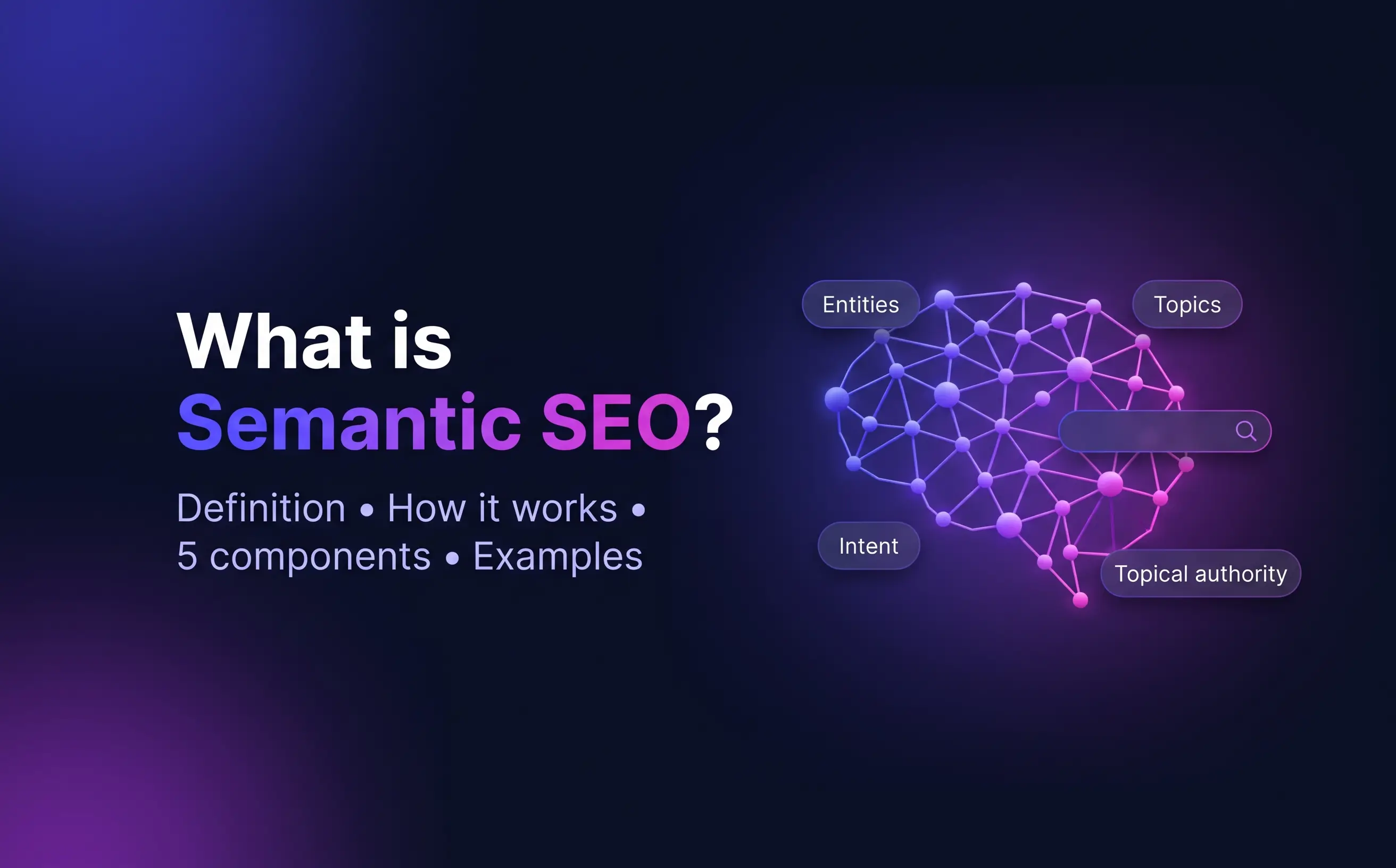
Semantic SEO is a search engine optimization method that builds content around entities, their attributes and the relations between them. Search engines read those relations to understand what a page means, in addition to the words on the page.
Semantic SEO works at two levels. On each page, semantic SEO states clear facts about one entity and its attributes. Across the site, semantic SEO plans which pages exist, in what order, and how the pages link to each other.
The method has 5 main components: entities, topical maps, semantic content networks, content briefs and internal links. A site that uses all 5 components covers its topic completely, and complete coverage is what Koray Tuğberk GÜBÜR's Topical Authority framework links to faster and broader rankings.
This guide defines semantic SEO, explains how semantic SEO works, describes its 5 components and shows 2 examples. It then covers the benefits, the common myths, the questions businesses ask and the first steps.
What is semantic SEO?
In search engine optimization, semantic SEO is a method that optimizes content for meaning by using entities, their attributes and their relations. The word "semantic" comes from semantics, the study of meaning in language. A semantic page is a page whose meaning a search engine can read without guessing.
Meaning in search starts with entities. An entity is a single, well-defined thing, such as a person, a place, a product or an idea. Google stores entities and the facts about entities in the Knowledge Graph. Google launched the Knowledge Graph on 16 May 2012 under the motto "things, not strings." In May 2020, Google reported over 500 billion facts about 5 billion entities in the Knowledge Graph.
Semantic SEO applies the same entity model to content. A page about storage units covers the attributes that define a storage unit: size, climate control, access hours and security. The page names the storage unit types, such as drive-up, indoor and climate-controlled units. The page states each fact in one clear sentence, for example "A 10x10 storage unit has 100 square feet of floor space." A search engine extracts those facts and matches the facts to the queries people type.
The two levels of semantic SEO have their own names:
- Microsemantics: the page level. Word choice, word order, sentence structure and the facts inside each section.
- Macrosemantics: the site level. Which pages exist, their headings, their URLs and the links between the pages.
What is the difference between semantic search and semantic SEO?
Semantic search is what the search engine does: the search engine reads the meaning of queries and documents. Semantic SEO is what a site owner does: the site owner structures content so that meaning is easy to read, extract and rank. The two sides meet at the query, and the way a search engine reads a query shows how semantic SEO works.
How does semantic SEO work?
Semantic SEO works by building pages the same way a search engine reads a query. Google breaks a query into parts, finds the entity, finds the attribute the searcher asks about, and ranks the pages that answer that entity and attribute best. Four parts explain the process: the Google systems that read meaning, the steps of reading one query, query fan-out in AI search, and the cost of retrieval.
Which Google systems read meaning?
“Google's ranking systems guide”, updated in December 2025, names 4 active systems that match the meaning of queries and pages:
- RankBrain (2015): connects words to concepts, so a page ranks for a query even without the query's exact words.
- Neural matching (2018): matches the concepts in a query to the concepts in a page.
- BERT (2019): reads how the words in a sentence change each other's meaning. Google said in February 2022 that BERT plays a role in almost every English query.
- Passage ranking (2021): ranks one section of a long page for a specific question.
Hummingbird, the 2013 update that older guides credit with semantic search, appears in the same guide as a retired system. Google still matches words as well as meaning, so the exact terms in headings and first sentences still count. These 4 systems work on every query, and the clearest way to see them at work is to follow one query.
How does Google read a query?
Google reads a query in 4 steps. Take the query "how long does topical authority take":
- Entity recognition: the entity is "topical authority."
- Attribute extraction: the attribute is time.
- Question format: "how long" asks for a duration.
- Answer matching: Google looks for passages that state a time range for topical authority.
A semantic SEO site prepares for those 4 steps before anyone searches. The topical map gives "topical authority" its own page. The content brief puts "how long does topical authority take" in a heading. The writer answers that heading in the first sentence under it, with a time range and the conditions that change the range.
How does query fan-out change semantic SEO?
Query fan-out raises the value of complete topic coverage. Google introduced AI Mode in May 2025, and Google's AI features documentation describes query fan-out for AI Overviews and AI Mode: the system runs several related searches across subtopics and data sources, then combines the results into one answer. A question such as "how do I start semantic SEO for a new site" becomes separate searches about topical maps, content briefs and publishing frequency. A site that covers all of those attributes appears in more of the sub-searches than a site with one isolated page. Covering every sub-search costs pages, and the number of pages a search engine processes has its own cost.
Why do search engines prefer well-structured sites?
Search engines prefer sources that are cheap to crawl, understand and rank. Koray Tuğberk GÜBÜR, who developed the Topical Authority framework, calls this processing cost the cost of retrieval. Clear, connected pages lower the cost of retrieval, and Koray reports that sites with a low cost of retrieval earn trust faster than sites with scattered pages. In his Search Engine Land article of 14 July 2026, Koray published his current topical authority formula: topical authority = ((historical data × topical coverage) ÷ cost of retrieval) × right visual annotations. Google has not published or confirmed this formula. A low cost of retrieval comes from 5 components that work together.
What are the main components of semantic SEO?
Semantic SEO has 5 main components that work as one system:
- Entities
- Topical maps
- Semantic content networks
- Content briefs
- Internal links
Entities are the subject of the content. The topical map plans which entities and attributes get a page. The semantic content network connects those pages, the content briefs tell writers how to build each page, and internal links carry relevance between the pages.
Entities
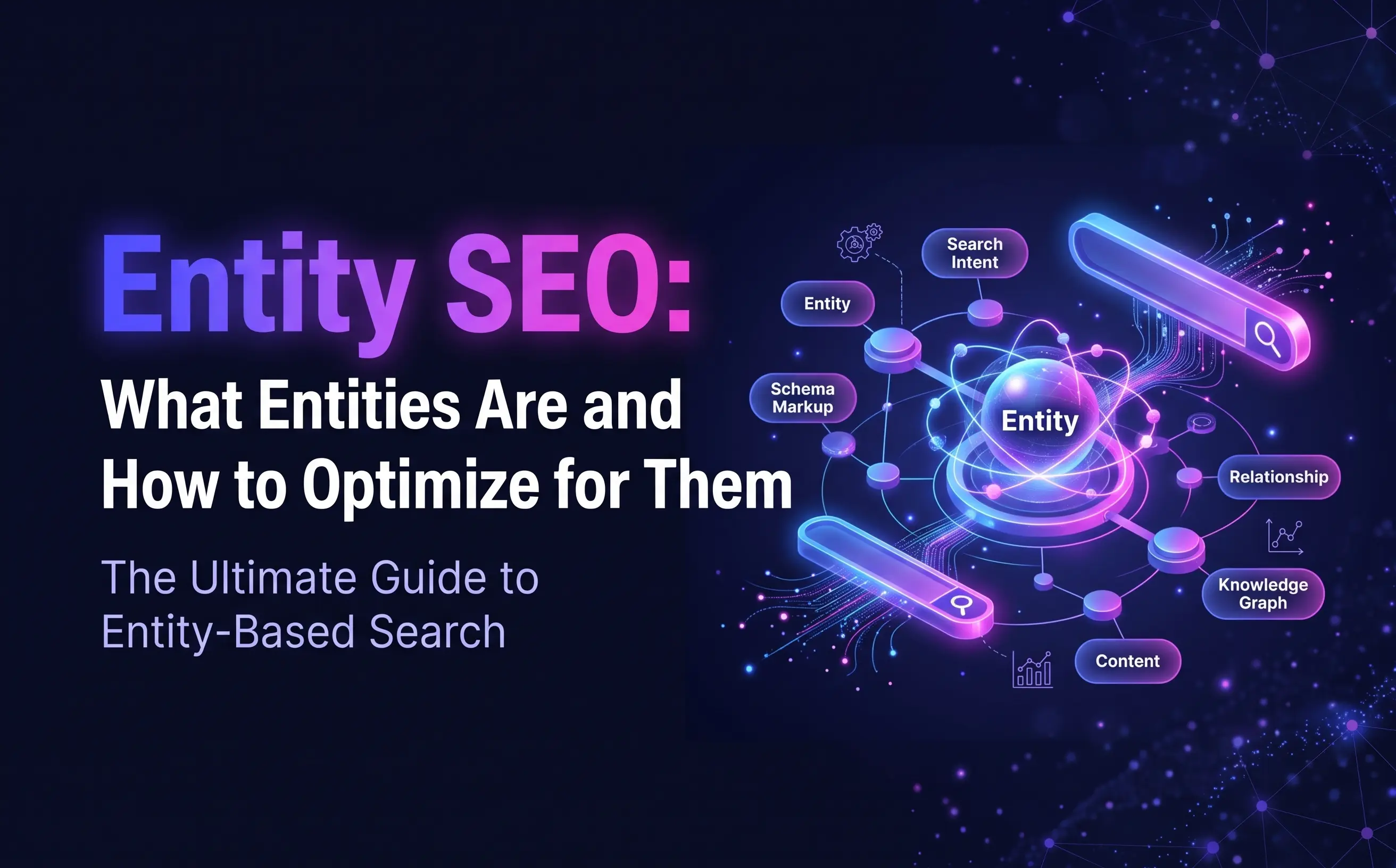
Entities are the people, places, products and concepts a site writes about, and the practice of optimizing a site around them is called entity SEO. Each entity has attributes, and each attribute has a value: the entity "Hope Diamond" has the attribute "carat weight" with the value "45.52 carats." Semantic SEO picks the attributes that matter for the site's business and covers those attributes in a fixed order, most important first. How to choose, order and mark up those attributes is the subject of entity SEO.
Topical maps
A topical map is the ordered plan of query groups and pages that a website publishes to earn topical authority on one central entity. The map names the central entity, splits topics into a core section (close to what the business sells) and an outer section (supporting topics), and sets the order of publishing. Koray's Search Engine Land article of 22 July 2026 explains the idea through the search index: "Google constructs an index. SEO creates a page." A topical map creation project builds this plan from a site's own queries and competitors.
Semantic content networks
A semantic content network is a group of connected pages that covers one entity and its attributes in a planned order. The network starts from a root page and grows through quality nodes. Koray's course teaches that a quality node is the long, detailed page where a site proves its quality against competing sites, while a page that answers one yes-or-no question stays short. How pages connect inside a semantic content network decides which pages pass relevance to which.
Content briefs
A content brief is the instruction document for one page. A semantic brief sets the headings and their order, the format of each section (paragraph, list or table), the entities and attributes to cover, the questions to answer and the internal links to place. Koray's course teaches 3 further brief columns: the preceding question that sets up each answer, the annotation text around each link, and a unique information gain score for each section. Koray's course teaches that content briefs are the first step of every semantic content network.
Internal links
Internal links connect the pages of a network and pass relevance between the pages. In semantic SEO, the anchor text matches the main phrase of the page the link points to, and the annotation text, the words around the anchor, states why the 2 pages connect. Koray's course adds a placement rule: the anchor phrase appears once in the section before the link itself.
What are examples of semantic SEO?
Two examples show semantic SEO at both levels: one page written for one query, and one site built for one topic.
Page example: "how much does it cost to move a 2-bedroom apartment"
The table compares how a keyword-focused page and a semantic page handle the same query.
| Part of the page | Keyword approach | Semantic approach |
| Target | The phrase "cost to move a 2-bedroom apartment" | The entity (moving service), the attribute (price) and the condition (2-bedroom apartment) |
| Research | Search volume of the phrase and its close variants | The attributes that change the price: distance, home size, moving date and packing services |
| Headings | The phrase repeated in several headings | One question per heading: local vs long-distance cost, how many movers a 2-bedroom move needs, the cheapest months to move |
| Facts | General claims such as "affordable rates" | Measured values: hourly rate per mover, price range by distance, number of movers and hours |
| Links | Links to other city pages | Links to pages on packing services, moving insurance and short-term storage |
The semantic page answers the question the searcher asked and the next questions the searcher asks. The semantic page ranks for many variations of the query, such as "long distance moving cost for a 2-bedroom apartment," because the page covers the attributes behind those variations.
Site example: a visa consultancy
Vizem.net, a visa application site, is one of Koray's published case studies. Koray's Oncrawl case study of January 2022 describes a topical map that placed countries at the center, with each country covered across the same attributes: visa types, documents, fees and application steps. Koray reports that the site grew from 0 to more than 9,000 daily clicks in 6 months, with no backlink campaign. Each new country network reused the structure of the previous one, and each new page reached its first rankings faster than the page before.
The definition, the process, the 5 components and these 2 examples describe semantic SEO itself. The rest of this guide covers what the method delivers and how to judge it, starting with its benefits.
What are the benefits of semantic SEO?
Semantic SEO has 4 main benefits, and all 4 benefits grow as the site covers more of its topic:
- More queries per page. A page that covers an entity's attributes ranks for many variations of the main query, including long questions nobody targeted directly.
- Faster rankings for new pages. Search engines give a new page a first ranking before they fully understand the page. Koray calls this first ranking the initial ranking. In his case studies, a well-built network can earn a higher initial ranking with each new page and shorter delays before indexing.
- Steadier rankings through updates. Koray describes topical authority as "a positive ranking state." Core updates re-test a site's pages, and Koray reports that sites with deep, connected coverage keep their positions more often than sites with scattered, thin pages.
- Visibility in AI answers. Google's AI features documentation states that a page must be indexed and eligible to show a snippet to appear as a supporting link in AI Overviews. Pages that already rank and state clear facts meet that condition.
These benefits take time. Topical authority depends on historical data, and historical data builds only as Google tests the site's pages over weeks and months. Much of what slows these benefits down is advice that Google's own documentation contradicts.
What are common myths about semantic SEO?
Semantic SEO has 5 common myths, and Google's own documentation answers each myth. The table lists each myth, the current fact and the source of the fact.
| Myth | What is true | Source |
| LSI keywords improve rankings | LSI keywords are not a Google concept. John Mueller of Google said so in July 2019. | John Mueller, Google, 2019 |
| Longer content ranks better | Length alone does not affect ranking. Google says there is no magical word count. | Google SEO Starter Guide |
| AI Overviews need special schema | No special structured data is needed to appear in AI Overviews or AI Mode. | Google Search Central, AI features |
| Hummingbird powers semantic search | Google lists Hummingbird as retired. RankBrain, neural matching, BERT and passage ranking do this work now. | Google ranking systems guide |
| E-E-A-T is a ranking factor | E-E-A-T comes from Google's quality rater guidelines. Google says E-E-A-T is not a ranking factor. | Google SEO Starter Guide |
The LSI myth is so widespread that in October 2026, Google's own AI Overview for "what is semantic SEO" still recommended LSI terms. With the myths set aside, the questions that remain are the practical ones a business asks before choosing the method.
What do businesses ask about semantic SEO?
Businesses ask 3 questions about semantic SEO before they invest: whether the method is worth the cost, how semantic SEO differs from traditional SEO, and whether semantic SEO still works in AI search.
Is semantic SEO worth it for a business?
Yes, semantic SEO is worth it for a business whose customers ask many questions before they buy, such as law firms, moving companies, self-storage facilities, jewelry stores and CBD or kratom shops. Each answered question becomes a page or a section that moves a buyer closer to a decision.
The method takes planning and patience. Koray reports that in one project the first top-3 rankings appeared 2 months after the first content network went live, and only 15 days after the second network went live. Results arrive faster once Google trusts the site.
A business has 2 ways to start: build the topical map and briefs in-house with a writer who follows semantic writing rules, or hire a semantic SEO specialist to plan the network and train the writers. Both ways start with the same step, a topical map that matches what the business sells, and both ways differ from traditional SEO in their unit of work.
How is semantic SEO different from traditional SEO?
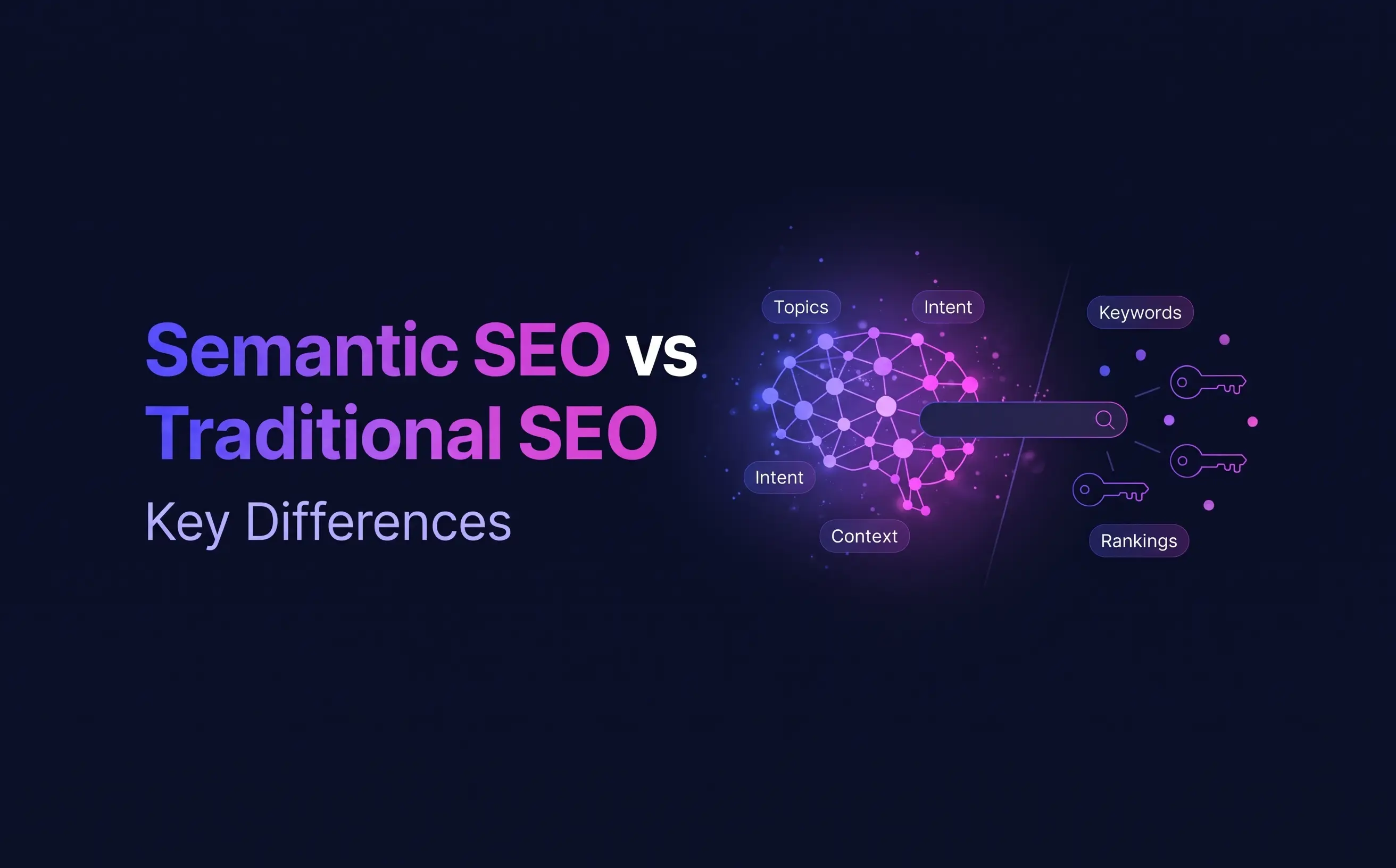
Semantic SEO differs from traditional SEO in its unit of work, and the comparison of semantic SEO vs traditional SEO starts there. Traditional SEO optimizes one page for one keyword and its close variants. Semantic SEO optimizes a network of pages for one entity and all of its attributes, so the whole site answers a topic. Both methods still need crawlable pages, good titles and links from other sites. The full comparison, with a table of 8 differences, is in semantic SEO vs traditional SEO.
Does semantic SEO work for AI search?
Yes, semantic SEO works for AI search, because AI answers draw on pages that already rank. Google's documentation for AI Overviews and AI Mode lists no extra requirements and no special schema: a page has to be indexed and eligible to show a snippet. Pages with one fact per sentence and a direct answer under each heading give these systems passages they can quote. ChatGPT search and Perplexity also search the web before their large language models (LLMs) write an answer. AI search optimization applies the same rules to Google's AI features, ChatGPT and Perplexity.
How do you start with semantic SEO?
To start with semantic SEO, define your source context first: what your site sells and to whom. Then follow 8 steps in order:
- Define the source context.
- Choose the central entity.
- Collect the queries around the central entity.
- Build a topical map.
- Write a content brief for each page.
- Write the pages.
- Link the pages and publish them in batches.
- Measure impressions in Google Search Console.
The goal of semantic SEO stays the same from the first step to the last: a site that covers its entities, their attributes and the relations between them so completely that search engines treat the site as the authority on its topic.
Let’s make Google see you as the expert.
Book a free call, or message me directly. I reply within one working day.