
Semantic SEO Content Writing Services
Every page starts from a brief that gives it one job, lists the facts it must state, and names what it will add that the pages already ranking don't. Then I write it, or your writers do. Either way, every claim is checked against a source.
Briefs in about 10 days. First pages in weeks 2 to 4. Every claim traceable to its source.
- 6+ years of experience
- 30+ clients served
- Completed Koray's Topical Authority course
Signs you need better content, not more content
- You publish blog posts, and they never reach page one.
- Your writers are good, but their articles look like the ones already ranking.
- You worry about the quality of AI-written content.
- Every writer structures pages differently, so the site feels inconsistent.
- Your service pages are thin because nobody knows what else to say.
- You rank for exact phrases but miss the related questions.
- Editing takes longer than writing, because the brief was one line.
What every brief contains
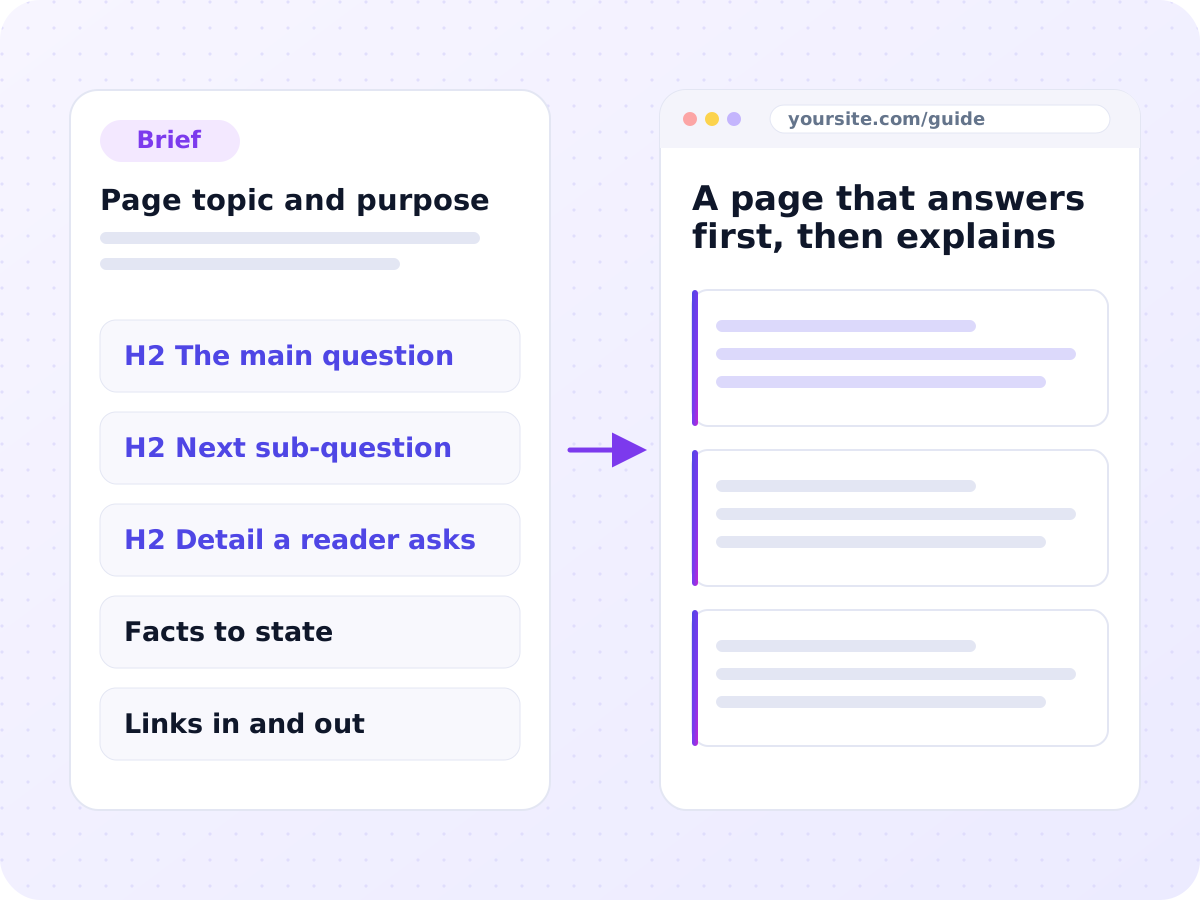
The brief holds the strategy. The writing makes it clear. Each brief starts from the page's row in your topical map, so its job is set before any heading is planned.
Macro and micro context
- What it decides
- The page's main topic and purpose, and the narrower sub-topics each section supports
- Example
- A kratom capsule page: choosing capsules, then leaf weight per capsule, shell types and batch lab testing
Heading order
- What it decides
- The main question first, then sub-questions in the order a reader asks them. Each heading moves the meaning one step forward
- Example
- A page on contesting a will: who can contest, the accepted grounds, time limits, likely costs
Facts to state
- What it decides
- Exact values instead of adjectives, consistent across the site
- Example
- A CBD page states the milligrams per bottle and the THC figure from the lab report, not "potent"
What the page adds
- What it decides
- The one thing the top results don't have, taken from your business, never invented
- Example
- A jeweler's own photos of natural and lab-grown stones under the shop's lighting
Answer-first sections
- What it decides
- Each section opens with a one- or two-sentence answer, then the detail, so it can stand alone
- Example
- A passage Google can rank on its own, and AI answers can quote cleanly
Links
- What it decides
- Which links go in, where in the sentence, with what words, and which older pages should link to the new one
- Example
- A unit-size guide linking to the facility page with "10x10 storage unit"
Keyword brief vs semantic brief
Briefs for your team, or pages written for you
The brief is the same either way. Only who turns it into a page changes.
Briefs for your team
Briefs for your team suit businesses with writers who know the product. Their knowledge supplies the angle, and the brief supplies the structure, facts and boundaries.
Pages written for you
Pages written for you suit businesses without time to write, or subjects that need research. I interview the people who know your business, collect the documents that prove its claims, and write from both.
How I use AI, and where I don't
- I use it to
summarize long documents (which I then read myself), spot patterns across ranking pages, and catch slips in edited drafts.
- I don't use it to
supply facts, write claims in regulated industries, or produce whole pages.
- Every claim
is checked against a primary source, and every cited source is opened. That includes titles, meta descriptions and alt text.
- Your confidential information
never goes into tools that train on what users type.
This follows Google's guidance on AI-assisted content: AI can help with research and structure, but pages made at scale without adding value can count as spam, and everything must be fact-checked before it goes live.
What you receive
Structure, facts and links for a draft that's right the first time.
Every claim traceable.
One voice, one term per concept, one set of formatting rules.
Claims that need evidence or sign-off.
Title, meta description, URL, alt text and markup notes, fact-checked like the body.
Loaded, formatted and linked, if you give me editor access.
Searches and impressions at 30 and 90 days.
How it works, step by step
Map check
Days 1 to 3Each page is checked against your topical map, or I sketch a small one, so no two pages share an intent.
Research
Days 3 to 7Ranking pages, searchers' questions and the facts each page needs. You send product details, policies and what only your business knows.
Briefs
Days 5 to 10A full brief for each page, approved by you before writing starts.
Writing
Weeks 2 to 4Your writers draft from the briefs, or I write the pages.
Edit and fact-check
Weeks 3 to 4Drafts are edited against the brief, and every factual claim is checked against its source.
Publish and link
Weeks 4 to 5Pages go live with their planned links, including new links from older pages.
How a page is judged
Search breadth
How many related searches the page appears for.
Intent match
Whether it ranks for its own searches, or for searches another page should own, which is an early sign of overlap.
Next step
Whether readers go on to the linked service or product page, or call, book or reserve.
New pages are compared with the trend of their section, not with day-to-day position changes.
Ways to work together
Briefs for your team
For teams who keep writing in-house.
A full brief per page, a writer style sheet, and feedback on first drafts against the briefs.
Done-for-you writing
For businesses that want publish-ready pages.
Brief, draft, edit and fact-check for each page, a publishing pack, and optional upload to your CMS.
Monthly content program
For sites working through a topical map in batches.
An agreed number of pages each month, links added to older pages as new ones go live, and monthly performance notes.
Is this right for you?
A good fit if you
- have a topical map or plan to build one
- have writers who need more than a keyword and a word count
- work in a regulated or YMYL industry
- would rather publish fewer strong pages than many weak ones
Not a good fit if you
- want high volume at the lowest price per word
- want product or legal claims stated more boldly than the rules allow
- can't review drafts and answer questions about your business
Content writing questions
How long should each page be?
As long as it takes to answer the questions in the brief. Length is a result, not a target, and padding weakens the useful parts.
Whose name goes on the pages?
The real person who knows the subject and reviewed the page, usually you or your expert. Google asks sites to make clear who created content, so I never invent authors or credentials.
Can you write in our brand voice?
Yes. I build a style sheet from your existing pages, sales emails and customer messages. The first page is a test, adjusted after your feedback.
Do you need time from our experts?
A little: a short interview per batch, and draft reviews. For YMYL pages, an expert review before publishing is essential.
Do you use Surfer or Clearscope?
Not as the method. They can be a last check for a missed sub-topic, but writing to a score pushes pages toward your competitors' wording.
Do you write service and location pages?
Yes, and they often gain the most. Location pages use details from your local staff.
What if a page doesn't perform?
I diagnose it first: indexing, which searches it shows for, overlap with other pages, and whether the brief misjudged the intent. The fix is usually a narrower scope, a stronger answer near the top, or better internal links.
Do you link to outside sources?
Yes, to primary sources: government and regulator pages, statutes, lab reports and manufacturer specifications. Never to competitors or thin aggregator pages.
Can you write before the site launches?
Yes, and it is the better order. The design fits real content, and the core pages launch complete.
Regulated industries need extra care with every claim. See the industries I work in.
Find out what your pages are missing.
Book a free 30-minute call. We go through your site together, and I show you the 3 fixes that matter most.