
Entity SEO: What Entities Are and How to Optimize for Them

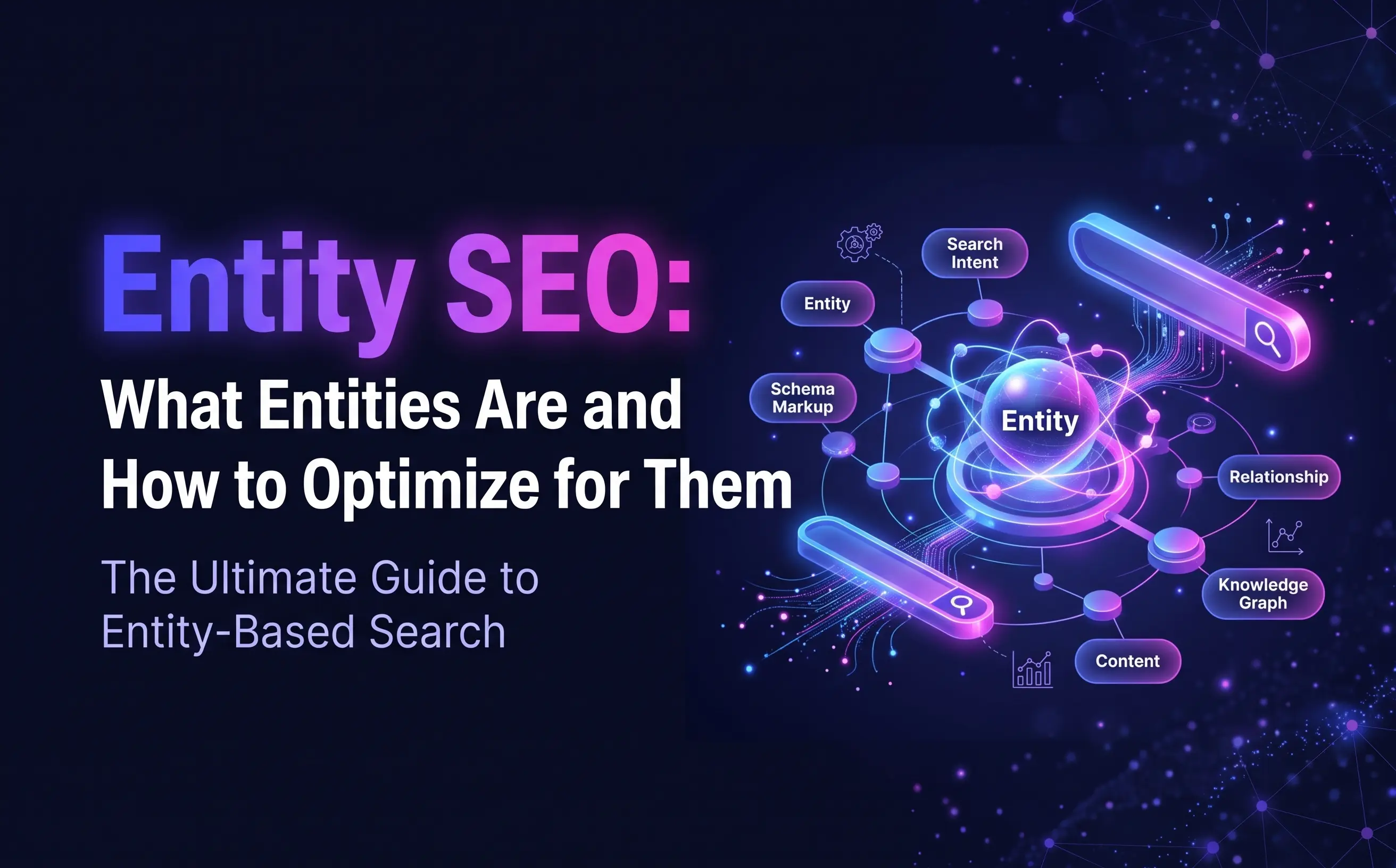
Entity SEO is a semantic SEO practice that optimizes a website around entities, their attributes and their relations, instead of around keyword strings. An entity is a single, well-defined thing or concept that a search engine identifies and connects to other entities. Google made this shift public on 16 May 2012, when it launched the Knowledge Graph under the title "things, not strings". Each entity has a type, attributes, relations and a way to be told apart from entities with the same name.
The sections below define an entity, list the 7 entity types and explain how Google recognizes entities. They then describe attributes and relations, give 8 optimization steps and name the common entity SEO mistakes.
What is an entity in SEO?
An entity in SEO is a thing or concept that is singular, unique, well-defined and distinguishable. The wording comes from Google's patent "Question answering using entity references in unstructured data", published in December 2016. A keyword is the text a person types. An entity is the thing that text refers to. Koray Tuğberk GÜBÜR widens the rule in a November 2022 case study: "Every concept is an entity, even if it doesn't have a name."
The entity table below breaks one entity, the Google Knowledge Graph, into its type, 3 attributes and 3 relations. Every fact in it comes from Google's own publications.
| Part of the entity | Label | Value |
| Entity | Name | Google Knowledge Graph |
| Type | Class | Knowledge base |
| Attribute | Owner | |
| Attribute | Launch date | 16 May 2012 |
| Attribute | Size at launch | More than 500 million objects and 3.5 billion facts |
| Relation | Powers | Knowledge panels |
| Relation | Draws facts from | Wikipedia and hundreds of other sources |
| Relation | Supplies facts to | AI Mode in Google Search |
How is an entity different from a keyword?
An entity differs from a keyword in what a search engine stores. A keyword is a string of characters, and an entity is a node with an identifier, a type and facts. The table below compares the two on 5 attributes.
| Attribute | Keyword | Entity |
| Unit | A string of characters in a query | A thing or concept with its own identity |
| Identifier | None besides the text | A Knowledge Graph ID, such as kg:/m/0dl567 for Taylor Swift |
| Meaning | Changes with context; [taj mahal] has 4 meanings | One meaning per entity |
| Language | Changes with each language | Stays the same across languages |
| Optimization unit | Placement and frequency of the string | Attributes, relations and context |
The move from strings to things is the main difference covered in semantic SEO vs traditional SEO. Each entity also belongs to a type, and the type decides which attributes the entity shares with others.
What are the types of entities in SEO?
There are 7 common types of entities in SEO: person, organization, place, product, event, creative work and concept. The table below maps each type to the entity types of Google's Cloud Natural Language API and to schema.org, the vocabulary behind Google's structured data.
| Entity type | Natural Language API type | schema.org type | Examples |
| Person | PERSON | Person | Marie Curie, Koray Tuğberk GÜBÜR |
| Organization | ORGANIZATION | Organization | Google, a local law firm |
| Place | LOCATION | Place | Lahore, Dubai Marina, the Taj Mahal |
| Product | CONSUMER_GOOD | Product | Toyota Corolla, a self-storage unit |
| Event | EVENT | Event | Google I/O, a Google core update |
| Creative work | WORK_OF_ART | CreativeWork | a book, a film, a podcast episode |
| Concept | OTHER | DefinedTerm | semantic SEO, calorie, topical authority |
The Natural Language API lists 13 types in total. The other 6, such as DATE, PRICE and ADDRESS, describe values more than things.
What are named and unnamed entities?
Named entities are entities with a proper name, such as Marie Curie or Lahore. Unnamed entities are entities referred to by a common noun, such as "calorie" or "storage unit". The Natural Language API marks each mention as PROPER or COMMON. An entity needs no Wikipedia page to exist. Google's May 2020 Knowledge Graph explainer names Wikipedia as one source among "hundreds of sources from across the web".
How does Google recognize entities?
Google recognizes entities by detecting mentions in text, typing them, linking each one to a known entity and scoring how central it is. Google's Cloud Natural Language API shows these 4 stages in a public tool:
- Detection: the API finds each mention of an entity in the text.
- Typing: the API assigns a type, such as PERSON or LOCATION.
- Linking: for most entity types, the API returns a Knowledge Graph machine ID (mid) and a Wikipedia URL.
- Salience: the API scores how central each entity is to the text, from 0 to 1.0.
The Natural Language API is a Google Cloud product, separate from Search ranking. Its output shows how a Google system reads entities. It says nothing about rankings. The linking stage is where entities with the same name get separated.
How does Google tell apart entities with the same name?
Google tells apart entities with the same name by reading the other entities and attributes around the mention. Amit Singhal's launch post of 16 May 2012 used the query [taj mahal]. The query has at least 4 meanings: the monument, a Grammy-winning musician, a casino in Atlantic City and a nearby Indian restaurant. Singhal called this benefit "Find the right thing".
Pages send the same signals. A page that names Agra and Shah Jahan refers to the monument, and a page that names albums and blues refers to the musician. Google's organization structured data guide, updated September 2026, says the markup helps Google "disambiguate your organization in search results". Both signals are entity attributes and relations.
What are entity attributes and relations?
Entity attributes are the properties that describe an entity, each with a value, and entity relations are the links that connect one entity to another. In the table above, "launch date: 16 May 2012" is an attribute with its value. "Powers knowledge panels" is a relation.
Both are written as triples. Koray defines a triple as the "subject, predicate, object" order of a statement (Search Engine Land, 12 August 2026). In the same article, Koray states that "Entities of the same type share the same set of attributes." Calorie is his example: every entity in the food class has a calorie value. A shared attribute set still leaves one decision open, which attributes reach the page.
How do you choose which attributes to cover?
To choose which attributes to cover, rank the attributes of the entity type by the site's source context and keep the ones that match it. The source context is the reason a website exists and the way it earns money. The table below is an illustration, built for this post with no client data behind it. It filters 8 attributes of one place entity, Dubai Marina, for 2 imagined websites: a moving company and a travel booking site.
| Attribute of Dubai Marina | Moving company website | Travel booking website |
| Building move-in rules | Keep | Drop |
| Service elevator booking | Keep | Drop |
| Truck parking and loading bays | Keep | Drop |
| Distance to the company's storage facility | Keep | Drop |
| Road access and traffic | Keep | Keep |
| Hotels | Drop | Keep |
| Beaches | Drop | Keep |
| Restaurants | Drop | Keep |
The entity stays the same in both columns. The source context decides which attributes reach the page, and the topical map in SEO decides which page each attribute set gets. Attribute selection is step 3 of the optimization process below.
How do you optimize for entities?
To optimize for entities, follow 8 steps from the site level down to a recognition check.
- Define the central entity and the source context. The central entity appears on every page. On qaimraza.com, the central entity is semantic SEO.
- List the entities of the topic. Collect them from top-ranking pages, Wikipedia articles and People Also Ask questions. Record each entity's type.
- Build an attribute table per entity type. Give every entity of one type the same attribute set, then filter it by source context.
- Write each fact as a clear triple. Put the entity in the subject position, one fact per sentence. Use the entity name where a pronoun blurs meaning.
- Give each main entity one page. One page holds one macro context and one main entity. Link entity pages by their relations, following the rules in internal linking for semantic SEO.
- Mark up the main entities with JSON-LD. Add Organization or Person markup with name, url, logo and sameAs. Google recommends the home page or "a single page that describes your organization".
- Keep entity facts consistent across the web. Match the name, address, founding date and description on the website, Google Business Profile, LinkedIn and directories. Koray calls this consensus: LLMs trust claims that many sources confirm.
- Check how Google reads the entity. Run the page text through the Natural Language API and check type, salience and mid. Search the brand in the Knowledge Graph Search API, and claim the knowledge panel if one exists.
Most entity SEO mistakes come from a skipped step.
What are common entity SEO mistakes?
There are 6 common entity SEO mistakes, and each one blurs the identity of an entity.
- Pronoun-heavy writing: "it" and "this" replace the entity name, so the subject of each fact is unclear.
- Markup that does not match the page: Google's structured data policies (July 2026) say "Don't mark up content that is not visible to readers of the page."
- Weak sameAs links: schema.org defines sameAs as a page "that unambiguously indicates the item's identity". A generic directory page fails that test.
- Conflicting facts across profiles: 2 founding years or 2 business names create 2 candidate entities.
- Two main entities on one page: Koray's content brief rules allow one main entity per page.
- Related-keyword lists treated as entity work: John Mueller of Google wrote in July 2019, "There's no such thing as LSI keywords."
These 6 mistakes close the main part. The sections below connect entity SEO to deeper topics on this site.
How do semantic triples and EAV extend entity SEO?
Semantic triples and the entity-attribute-value model extend entity SEO from single facts to full attribute coverage. A triple holds one fact: "Google Knowledge Graph | launched on | 16 May 2012". An entity-attribute-value row stores the same fact in 3 cells. A spreadsheet of these rows becomes the attribute table from step 3. The full method is in semantic triples and entity-attribute-value (EAV) in SEO.
How does entity SEO relate to the Google Knowledge Graph?
Entity SEO relates to the Google Knowledge Graph as the work that gives the graph clear, consistent facts about an entity. Danny Sullivan of Google wrote in May 2020 that the Knowledge Graph "has amassed over 500 billion facts about five billion entities". That is Google's last public figure. The 1.6 trillion facts about 54 billion entities that Ahrefs cites (May 2026) comes from Kalicube, not from Google.
The Knowledge Graph also removes entities. Jason Barnard reported in Search Engine Land (August 2025) a drop of 6.26% on 13 and 20 June 2025, with over 3 billion entities deleted. Event entities fell 76.91%. How entities enter and stay in the graph is covered in Google Knowledge Graph SEO.
Knowledge panels are the visible part of the graph, and the claim process is in how to get a Google knowledge panel.
Which structured data supports entity SEO?
Organization and Person markup with @id and sameAs supports entity SEO most directly. The JSON-LD specification defines @id as the keyword "used to uniquely identify node objects". The sameAs property points to pages that confirm the entity's identity. The example below shows one organization with a stable @id and 2 sameAs links.
{
"@context": "https://schema.org",
"@type": "Organization",
"@id": "https://www.example.com/#organization",
"name": "Example Movers",
"url": "https://www.example.com/",
"logo": "https://www.example.com/logo.png",
"sameAs": [
"https://www.linkedin.com/company/example-movers",
"https://www.youtube.com/@examplemovers"
]
}
Article pages then reference the same @id as publisher. The schema.org properties about and mentions mark a page's subject and the entities it refers to, though Google documents neither as a search feature. Property choices per entity type are in structured data for entity SEO.
Which tools help with entity SEO?
There are 4 Google tools that help with entity SEO, and each one checks a different stage of recognition.
- Cloud Natural Language API: returns each entity's type, salience, mid and Wikipedia URL.
- Knowledge Graph Search API: finds entities by name. Google calls it read-only and "not suitable for use as a production-critical service".
- Rich Results Test: tests structured data against Google's technical guidelines.
- Google Search results: knowledge panels and "People also search for" show which entities Google connects.
The language processing behind the first tool is explained in NLP in SEO.
Can a small business become an entity?
Yes, a small business becomes an entity once Google identifies it as one distinct organization, with no Wikipedia page needed. Google's May 2020 Knowledge Graph post says local businesses manage details such as opening hours through their own business listing. Organization markup and matching facts on every profile complete the signal.
Do AI Overviews need special entity markup?
No, AI Overviews and AI Mode need no special entity markup. Google's AI features guide, updated December 2025, says "There's also no special schema.org structured data that you need to add." Google's May 2025 overview of AI Overviews and AI Mode says AI Mode uses facts from the Knowledge Graph. More on AI answers is in LLM SEO.
How do entities build topical authority?
Entities build topical authority when a site covers every entity of a topic with the attribute set its source context needs. Koray calls the mix of entity-attribute coverage and query template coverage "the strongest of these approaches" (Search Engine Land, 12 August 2026). His 2026 formula for topical authority divides historical data times topical coverage by the cost of retrieval. The formula is his own heuristic, not a Google formula. Entity SEO starts with one well-defined entity, its attributes and its relations. Topical authority grows as a site repeats that work for every entity of its topic.
Let’s make Google see you as the expert.
Book a free call, or message me directly. I reply within one working day.