
Google Ads Management Services
I plan, build and run your Google Ads from the same map of searches as your SEO, so your ads and your pages answer the same buyers. Every lead and sale is traced back to the search behind it. You work with me directly, and you own the account.
Tracking fixed in week 1, before any budget change. The free call covers your ad account too.
- 6+ years of experience
- 30+ clients served
- Completed Koray's Topical Authority course
Signs your Google Ads need work
- You spend every month and can't say which keywords bring customers.
- Reports show clicks and impressions, but not leads or calls.
- Many of the searches you pay for have nothing to do with what you sell.
- Performance Max spends money and you can't see where.
- Ads keep getting disapproved and nobody explains why.
- Every ad sends people to your homepage.
- Your SEO and your paid search are run by people who never talk.
One query map for ads and SEO
Ads and SEO answer the same searches, so I plan both from one source: your topical map, the list of topics and questions your buyers search, grouped by intent. Ads bring buyers this week while organic rankings grow. Once a page ranks well, I check whether its ads are still worth paying for, and move budget to searches you don't own yet.
Search pattern (for example, service plus city)
- What it decides in SEO
- A section of pages
- What it decides in Google Ads
- An ad group with its own copy and landing page
The intent behind the pattern
- What it decides in SEO
- What the page leads with
- What it decides in Google Ads
- The ad's message, call to action and bid. A price search gets a price-range page, an urgent search gets a phone number
Where a topic ends
- What it decides in SEO
- What the page leaves to other pages
- What it decides in Google Ads
- Negative keywords. A storage business blocks searches for sheds
Searches that convert
- What it decides in SEO
- Which page to build or rewrite next
- What it decides in Google Ads
- Where budget goes next
Which campaign does which job
Search
- Its job
- Catches people typing a specific need. The most control and the clearest data
- What it needs
- The base of most accounts
Performance Max
- Its job
- Runs across Search, Shopping, YouTube, Display and Maps
- What it needs
- Strong conversion data, brand exclusions and checked assets, or it takes credit for searches you'd get anyway
Shopping
- Its job
- Shows products with image and price from your Merchant Center feed
- What it needs
- Clean product titles and attributes, because they decide which searches match
Local Services Ads
- Its job
- Sits above other ads where Google offers it for your category and country. You pay per lead, not per click
- What it needs
- Google verification and reviews, which overlap with local SEO
Tracking you can trust before any spend
Smart bidding learns from what you count, so wrong counts teach it wrong lessons. Tracking is fixed first, in four layers.
- Conversion tags
- Forms, bookings and purchases, set up through Tag Manager, with GA4 key events for analysis
- Enhanced conversions
- Sends hashed first-party data, such as an email, so conversions still match when cookies are missing
- Call tracking
- Calls from ads and from the website, with a minimum length so accidental calls don't count
- Offline conversions
- Booked jobs, signed clients or paid orders from your CRM, credited to the original click, so bidding values real customers over time-wasters
Consent Mode respects visitors' choices where privacy law requires it.
How ad data feeds your SEO
Every month I sort the searches that triggered your ads into three groups:
Converting searches with no page
Candidates for a new SEO page.
Converting searches with a weak page
Candidates for a rewrite.
Wasted searches
New negative keywords, and a check on whether your site blurs two topics.
The same report shows details buyers ask about that competitors ignore, such as access hours, size limits or how a consultation works. Those go onto the page.
Ads that land on real pages
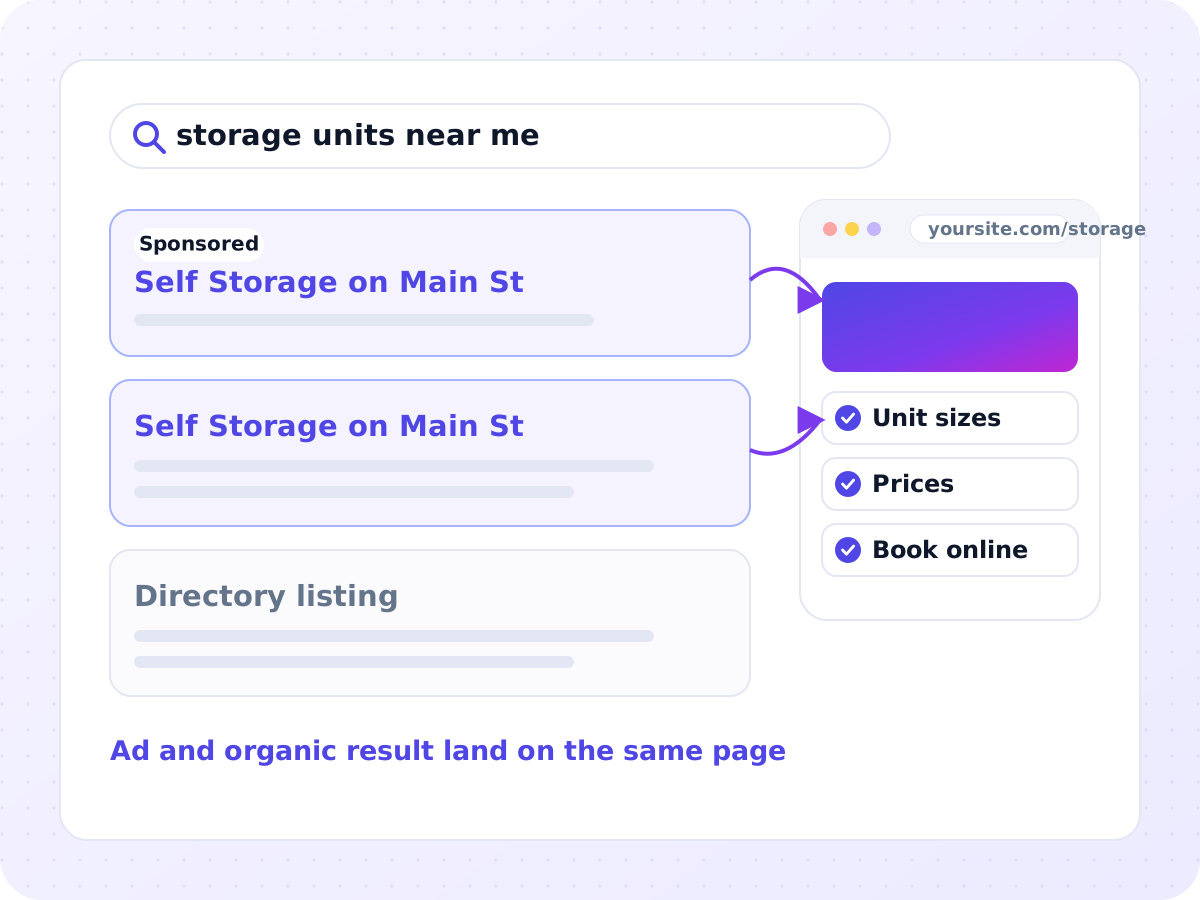
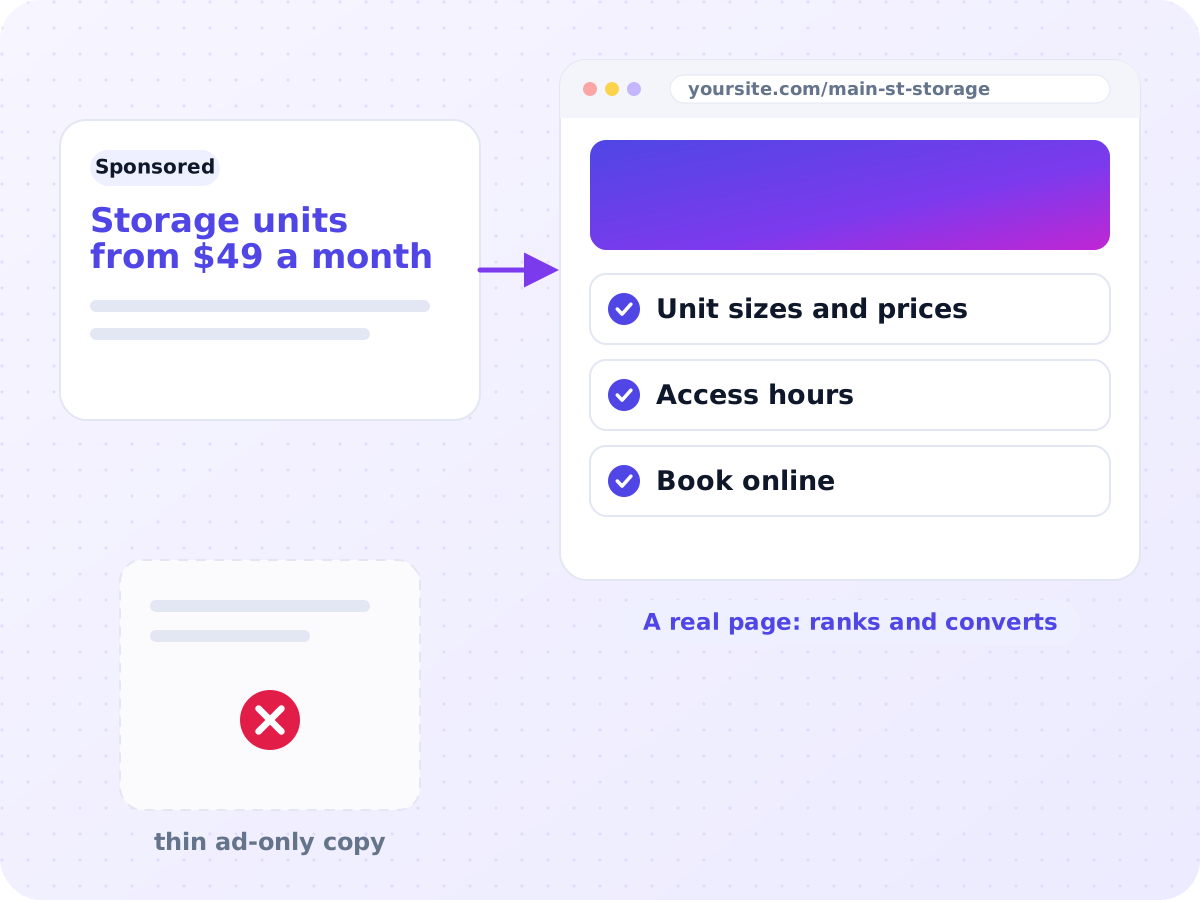
Ads point to the strong, linked pages of your site, not thin copies made only for ads. One good page helps both: Google judges organic relevance and the ads landing page experience on the same things, relevance, clarity and usefulness. For a short offer or a strict A/B test, I use a separate page set to noindex, so it never competes with your organic page.
Google Ads for restricted products
- Kratom
is not accepted for Google Ads. Don't try to disguise it: hidden products and cloaked pages risk suspending your account and any linked accounts.
- Ingestible CBD
is not allowed. Some topical hemp-derived CBD products can run in a few US locations, with LegitScript certification and Google's approval.
- Legal services
can advertise, but some legal categories are restricted.
- Movers, self storage and jewelry
follow standard policies. The usual problems are unsupported claims like "guaranteed lowest price", or free offers with hidden conditions.
Policies change, so every product is checked against Google's current policy before any spend.
What you receive
Where spend leaks and tracking breaks.
Ad groups mapped to search patterns, landing pages and match types.
Forms, calls and purchases, with enhanced conversions.
Checked against policy.
Pages to build or strengthen.
Spend, leads, cost per lead and revenue.
What you can advertise and what certification you need.
How it works, step by step
Audit and access
Days 1 to 3I review the account, tracking and landing pages. You give access to Google Ads, GA4, Tag Manager, and Merchant Center if you sell online.
Tracking first
Week 1Conversion tracking is fixed or built, including lead stages from your CRM, before any budget change.
Structure from the query map
Weeks 1 to 2Campaigns, ad groups and negatives built from the SEO research, with landing pages agreed with you.
Build and policy check
Week 2Copy, assets and feeds are checked against policy, and you approve before launch.
Launch and learning
Weeks 3 to 6Daily checks on search terms, budgets and disapprovals.
Improve and feed SEO
MonthlyPruning, ad and page tests, and converting searches passed to the content plan.
Ways to work together
Account rebuild
For accounts with wasted spend or broken tracking.
Full audit, tracking rebuild, a new structure from the query map, and four weeks of management after launch.
Monthly management
For campaigns running alongside SEO.
Search-term mining and negatives, ad and landing page tests, a monthly report with SEO recommendations, and direct email access.
Setup for your team
For in-house marketers.
Campaign build, conversion tracking, a recorded walkthrough of the account and two review calls after launch.
Is Google Ads right for you?
A good fit if you
- run a local service where a call turns into a job
- sell online with a clean product feed and known margins
- invest in SEO and need revenue meanwhile
- share CRM or sales data
- advertise in a regulated field that needs careful setup
Not a good fit if you
- sell products Google prohibits
- want campaigns you set once and forget
- judge ads on clicks instead of leads or sales
- have no landing pages or tracking and no plan to add them
Google Ads by industry
- Movers:
Local Services Ads and route or service Search campaigns, with the USDOT number in copy for interstate work. Call tracking comes first. The search side is my Moving Company SEO work.
- Self storage:
one campaign per facility, ad groups by unit size and feature, landing on the facility page with online rental. The search side is my Self Storage SEO work.
- Jewelry:
Shopping and Search together. The feed carries metal, karat, carat, cut, stone and certification, and lab-grown pieces are labeled as the FTC guides require. The search side is my Jewelry SEO work.
- Law firms:
campaigns by practice area and jurisdiction, copy within state bar rules, ad schedules that match intake hours. The search side is my Law Firm SEO work.
- Kratom and CBD:
usually no Google Ads, so organic search carries the sales. For kratom and CBD, the search side is my Kratom SEO and CBD SEO work.
More on each: the industries I work in.
Google Ads questions
Do Google Ads improve my organic rankings?
No. The two systems are separate. But ad data shows quickly which pages to build, and ads make your brand familiar.
Should I bid on my own brand name?
Often yes, if competitors bid on it. If they don't, brand ads may pay for visits you'd get anyway. Auction insights and a short pause test decide.
Can you take over my existing account?
Yes, and it's better than starting fresh. You keep the conversion history and audiences. I audit, fix tracking, then change the structure.
Who owns the account and the data?
You do. I work through manager access you can remove at any time, and the setup is documented for whoever comes next.
What happens if an ad is disapproved?
It stops until it's fixed. I read the reason in Policy Manager, fix the cause and request a review, or appeal if the decision looks wrong.
Do you apply Google's automatic recommendations?
Most are switched off after review. Useful fixes, like a broken tag or a missing asset, are kept. Anything that broadens matching or raises budgets is judged case by case.
Do Local Services Ads charge per click?
No, per lead. I review leads regularly and flag invalid ones for credit where Google allows it.
Can it work on a small budget?
Yes, if it's focused on the highest-intent searches, the areas you serve and the hours you can answer. One well-run campaign beats five weak ones.
Find out where your ad budget is leaking.
Book a free 30-minute call. We go through your site and your ad account together, and I show you the 3 fixes that matter most.